
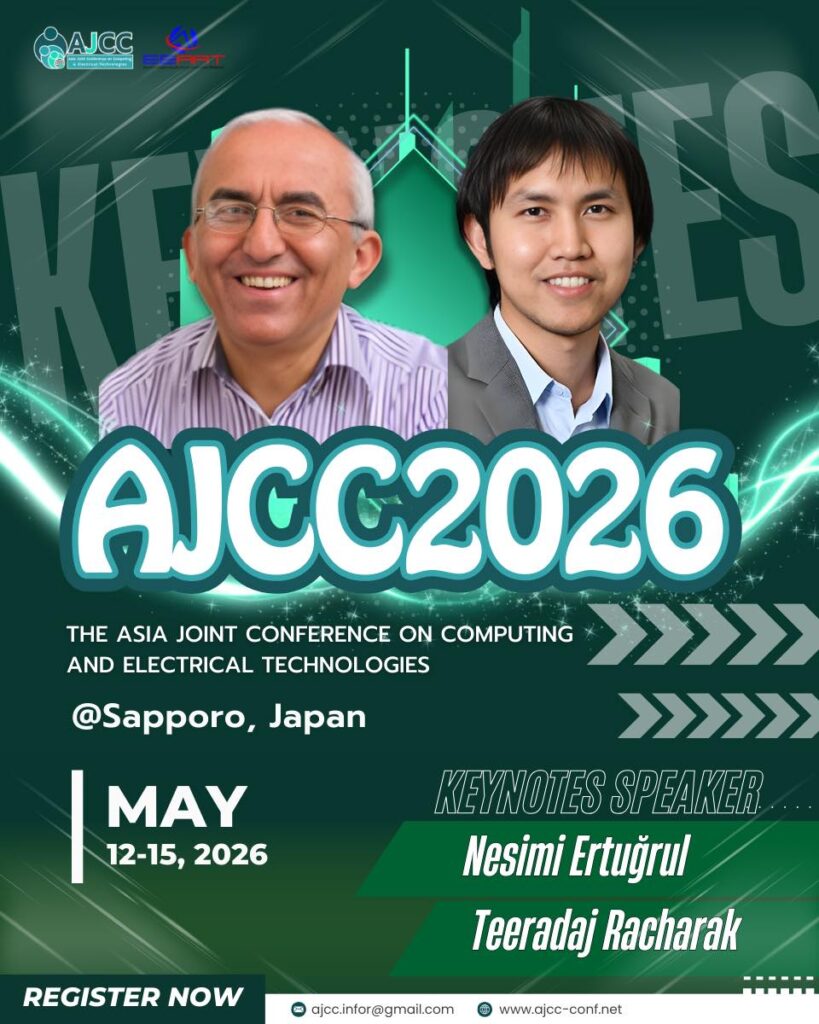
We are proud to present our distinguished Keynote Speakers for AJCC2026: Prof. Nesimi Ertuğrul, Ph.D., Adelaide University and Assoc. Prof. Teeradaj Racharak, Ph.D. Tohoku University, Join us in Sapporo, Japan (May 12–15, 2026) for the 7th Asia Joint Conference on Computing and Electrical Technologies (AJCC2026), where leading experts will share cutting-edge research, real-world innovations, and future perspectives in computing and electrical technologies.
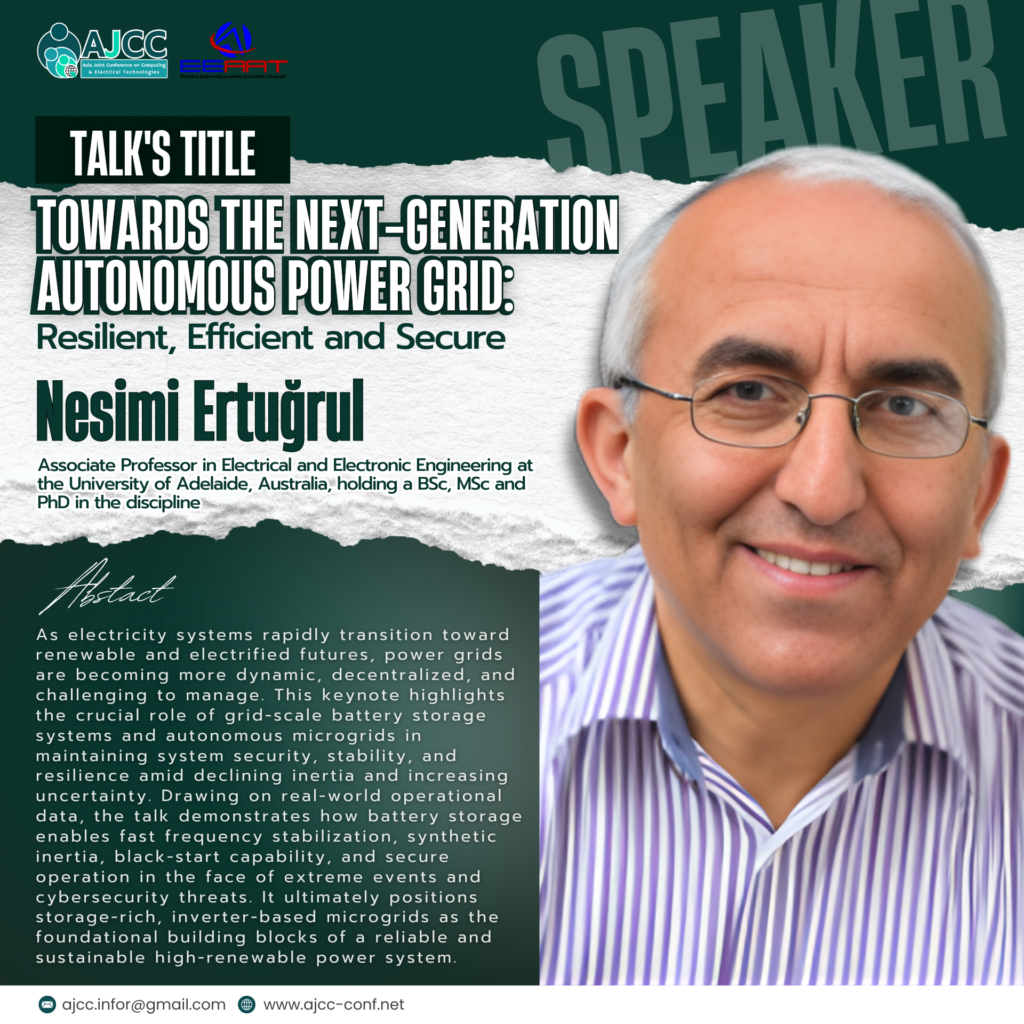
Prof. Nesimi Ertuğrul, Ph.D.
Adelaide University
Title: Towards the Next-Generation Autonomous Power Grid: Resilient, Efficient and Secure
Abstract
The global transition toward renewable energy is fundamentally reshaping electricity networks, replacing traditional synchronous generation with inverter-based resources. This shift is occurring alongside a massive wave of electrification; including the rapid adoption of electric vehicles, heat pumps, data centres, and mine electrification, which creates a highly dynamic and less predictable load landscape. Such changes require a paradigm shift in grid management to address declining inertia, frequency instability and the complex bidirectional power flows. This keynote explores the critical role of grid-scale Battery Storage Systems and autonomous microgrids as mature engineering solutions to ensure the power system security, efficiency and resilience of these evolving systems. Based on high-resolution field data from operational installations, the capability of Battery Storage Systems to provide sub-second frequency stabilization is demonstrated, alongside synthetic inertia and black-start capabilities. These features are identified as vital for maintaining system security as the grid moves away from fossil-fuel-based spinning reserves, directly addressing extreme weather events and environmental concerns while preserving reliability. As the grid becomes increasingly digitized and decentralized, the critical challenge of cybersecurity is addressed. With millions of connected devices forming an expanded attack surface, the discussion focuses on how autonomous frameworks must be “secure by design,” capable of detecting anomalies and maintaining local stability even during communication compromises. Finally, the performance of autonomous microgrids is analysed through real-world active-reactive operating envelopes and inverter-based coordination. It is demonstrated that these storage-rich, power-electronic-controlled nodes serve as the essential structural building blocks for a resilient, high-renewable national grid. A technical roadmap is provided for scaling these technologies across community, industrial and fast-charging infrastructures, ensuring a stable, secure and sustainable pathway for the next generation of global electrification. Real-time electrical quantities are further demonstrated under both normal and faulty operating states to validate these findings.
Biography
Dr. Nesimi Ertuğrul is an Associate Professor in Electrical and Electronic Engineering at the University of Adelaide, Australia, holding a BSc, MSc and PhD in the discipline. His extensive research portfolio is uniquely aligned with the core themes of modern power systems, specifically focusing on wide bandgap device power electronics for renewable energy integration, battery storage, electric vehicles and emerging magnetic materials for high-efficiency electrical machines. Beyond hardware, his work involved interactive engineering education and the development of DC-powered micro and nano grids. With a distinguished track record, Dr. Ertuğrul has supervised over 30 PhD and Master students, led numerous research grants, and authored over 190 peer-reviewed publications, five patents and four solo-authored books.
A Senior Member of IEEE and former Associate Editor of the IEEE Systems Journal, he has a long history of international leadership, including chairing global conferences and delivering keynote addresses. His most recent contributions to the field include two authoritative technical books published by CRC Press in 2025: Reinventing the Power Grid: Renewable Energy, Storage, and Grid Modernization and Techno-Economics of Offshore Renewable Energy.
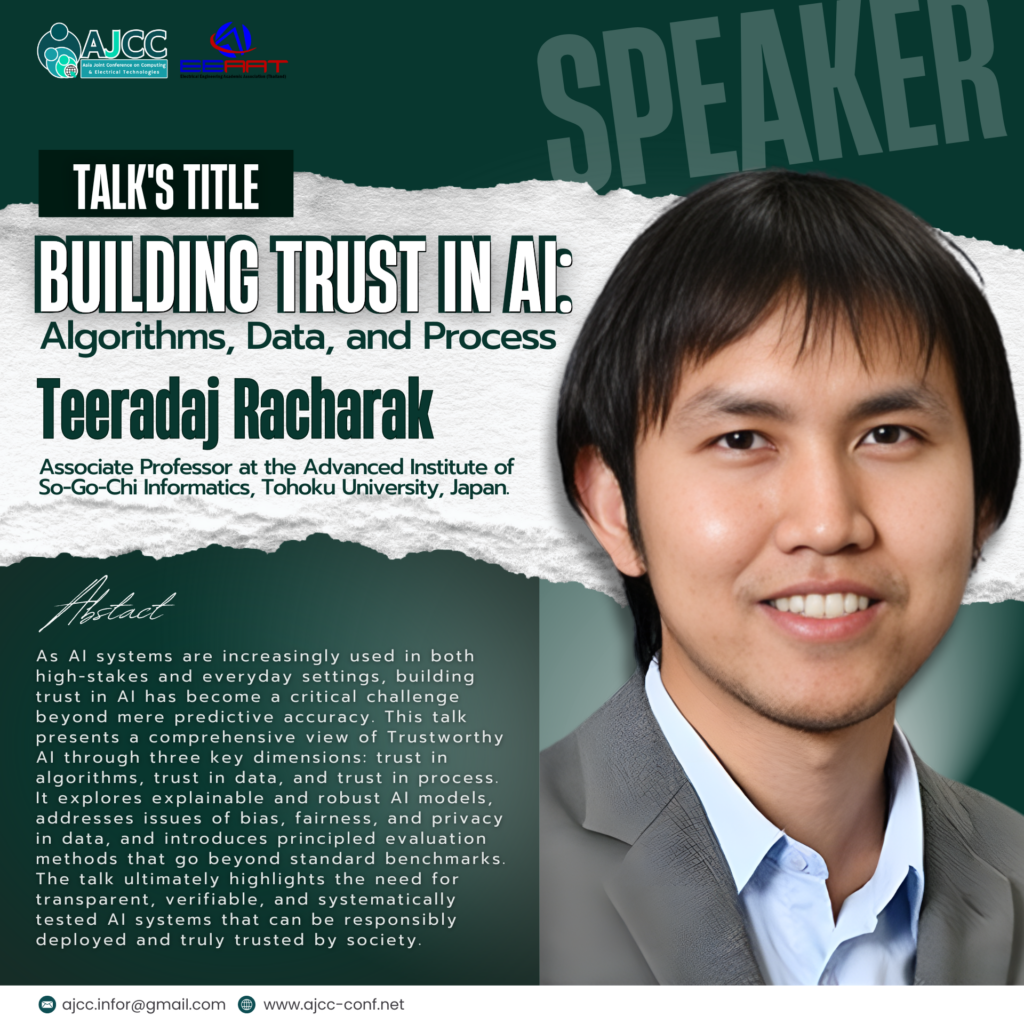
Assoc. Prof. Teeradaj Racharak, Ph.D.
Tohoku University
Title: Building Trust in AI: Algorithms, Data, and Process
Abstract
As artificial intelligence systems are increasingly deployed in high-stakes and everyday applications, ensuring their trustworthiness has become a fundamental challenge. Trustworthy AI extends beyond achieving high predictive accuracy; it requires transparent reasoning, robustness to variation, fairness in data usage, and principled evaluation processes that stakeholders can rely on.
In this talk, I present a comprehensive perspective on verifiable and trustable AI, structured around three core dimensions: trust in algorithms, trust in data, and trust in process. First, I review approaches to algorithmic trust, highlighting explainable and interpretable models across machine learning, computer vision, natural language processing, and knowledge representation. Examples include logic-based explanations for ontological reasoning, neuro-symbolic classifiers grounded in argumentation theory, robustness to negation in question answering, and human-friendly explanations generated from formal structures.
Second, I address trust in data by examining algorithmic bias, fairness, and privacy. Through case studies on gender bias in word embeddings and knowledge graphs, as well as privacy-preserving learning via federated learning and knowledge distillation, I illustrate how data quality and representation critically shape AI behavior.
Finally, I argue that trust must be established at the process level, not only at the model level. I introduce metamorphic testing and underspecification analysis as principled tools for evaluating AI systems when traditional benchmarks and test oracles fall short. These methods reveal that models with similar accuracy may rely on fundamentally different (and sometimes spurious) features, underscoring the limitations of accuracy-centric evaluation.
Overall, this talk advocates a shift toward principled AI deployment, where explanation, verification, and systematic testing work together to support responsible, transparent, and trustworthy AI systems.
Biography
Teeradaj Racharak is an Associate Professor at the Advanced Institute of So-Go-Chi Informatics, Tohoku University, Japan.
His research lies at the intersection of artificial intelligence, logic, and machine learning, with a particular focus on explainable AI, trustworthy AI, and neuro-symbolic reasoning. Dr. Racharak’s work spans knowledge representation and reasoning, natural language processing, computer vision, and argumentation-based learning. He has contributed to logic-based explanation for ontological reasoning, interpretable classification models
grounded in abstract argumentation theory, robustness analysis of language models, bias analysis in knowledge graphs, and principled evaluation frameworks such as metamorphic testing and underspecification analysis. His research has been published in leading venues including SIGIR, ISWC, ICONIP, ICTAI, and CLAR.
In addition to his academic work, Dr. Racharak serves as a technical committee member of ISO/IEC JTC 1/SC 42 (Artificial Intelligence), contributing to international AI standardization efforts. He is also a Visiting Associate Professor at the Japan Advanced Institute of Science and Technology (JAIST). His current research aims to establish principled foundations for building verifiable, transparent, and trustworthy AI systems across domains.